
Sustainable investment priorities, particularly related to climate, are critical to institutional investors, according to Morningstar’s most recent Asset Owner Perspectives Survey. Yet how investors measure progress in identifying companies successfully positioned to weather the climate transition lacks consistency, according to new insights from Morningstar Indexes and Morningstar Sustainalytics.
“The wide range of approaches to measuring progress against climate transition goals is evident in the two net zero frameworks used most by financial institutions today,” said Alicia White, director of climate and nature solutions with Morningstar Sustainalytics. “The FINZ Standard, from the Science Based Target Initiative, takes a top-down approach to measuring company progress toward meeting net zero commitments by evaluating the financial institutions holding the companies, while NZIF 2.0 from the Institutional Investors Group on Climate Change takes a bottom-up approach, assessing climate readiness on a company level.”
To better understand these theoretical frameworks and the practical benefits and challenges for investors using them, Morningstar mapped both against the Morningstar Global Target Market Exposure Index, representing the performance of large- and mid-cap stocks in developed and emerging markets, using the Sustainalytics Climate Transition Toolkit.
The analysis identified a number of notable insights including:
- Just 6.7% of the index qualifies as "aligned to a net zero pathway," with no constituents below a 1.5°C Implied Temperature Rise.
- Stated climate targets don’t reflect real-world progress: 28.6% of index weight scores below 2°C on ambition.
- Energy is the weakest sector under both frameworks, with no constituent reaching "aligned" status under NZIF, even though it's the sector where engagement and transition financing carry the most influence.
Energy Remains Climate “Hot Spot” According to Morningstar
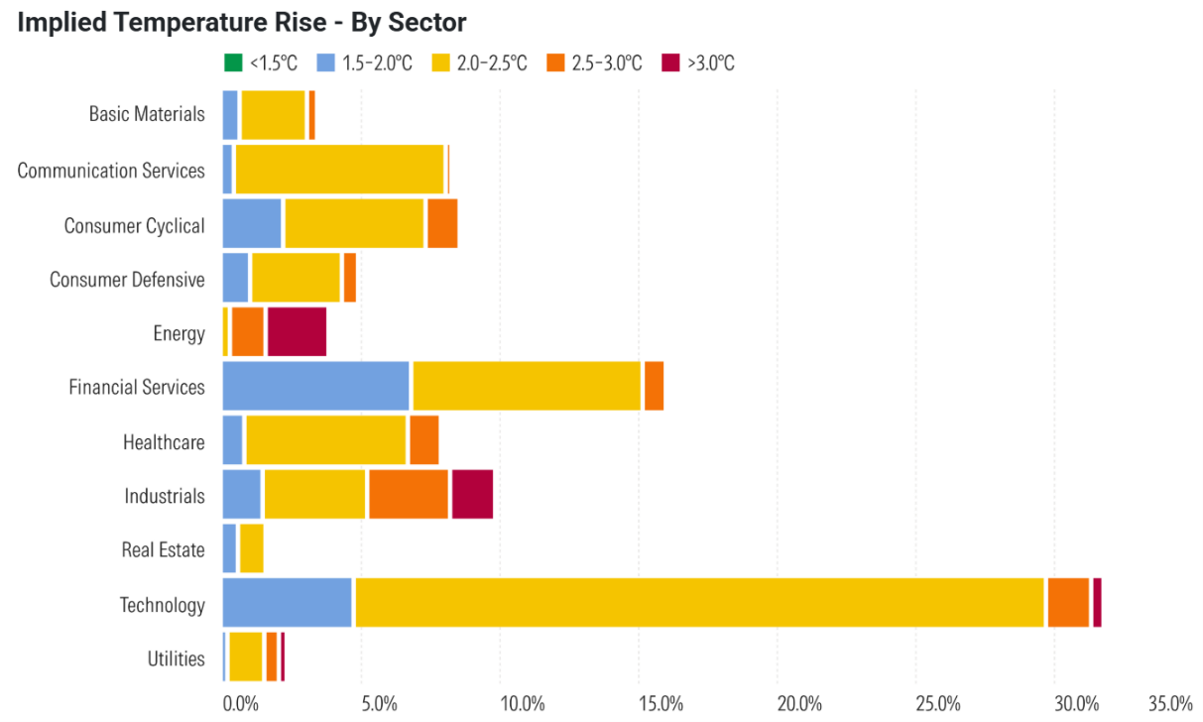
Source: Morningstar Sustainalytics. Data as of June 3, 2026.
“Regardless of what framework investors use to analyze the climate transition readiness of their portfolio, combining empirical data and real-world performance ensures a more realistic assessment,” added Maggie Stafford, director of product management with Morningstar Indexes. “Our analysis identifies the complementary nature of combining a top-down and bottom-up approach to measuring climate transition readiness while identifying how far we still need to go in addressing the climate transition gap.”
©2026 Morningstar. All Rights Reserved. The information, data, analyses and opinions contained herein (1) include the proprietary information of Morningstar, (2) may not be copied or redistributed, (3) do not constitute investment advice offered by Morningstar, (4) are provided solely for informational purposes and therefore are not an offer to buy or sell a security, and (5) are not warranted to be correct, complete or accurate. Morningstar has not given its consent to be deemed an "expert" under the federal Securities Act of 1933. Except as otherwise required by law, Morningstar is not responsible for any trading decisions, damages or other losses resulting from, or related to, this information, data, analyses or opinions or their use. References to specific securities or other investment options should not be considered an offer (as defined by the Securities and Exchange Act) to purchase or sell that specific investment. Past performance does not guarantee future results. Before making any investment decision, consider if the investment is suitable for you by referencing your own financial position, investment objectives, and risk profile. Always consult with your financial advisor before investing.
Indexes are unmanaged and not available for direct investment.
Morningstar indexes are created and maintained by Morningstar, Inc. Morningstar® is a registered trademark of Morningstar, Inc.